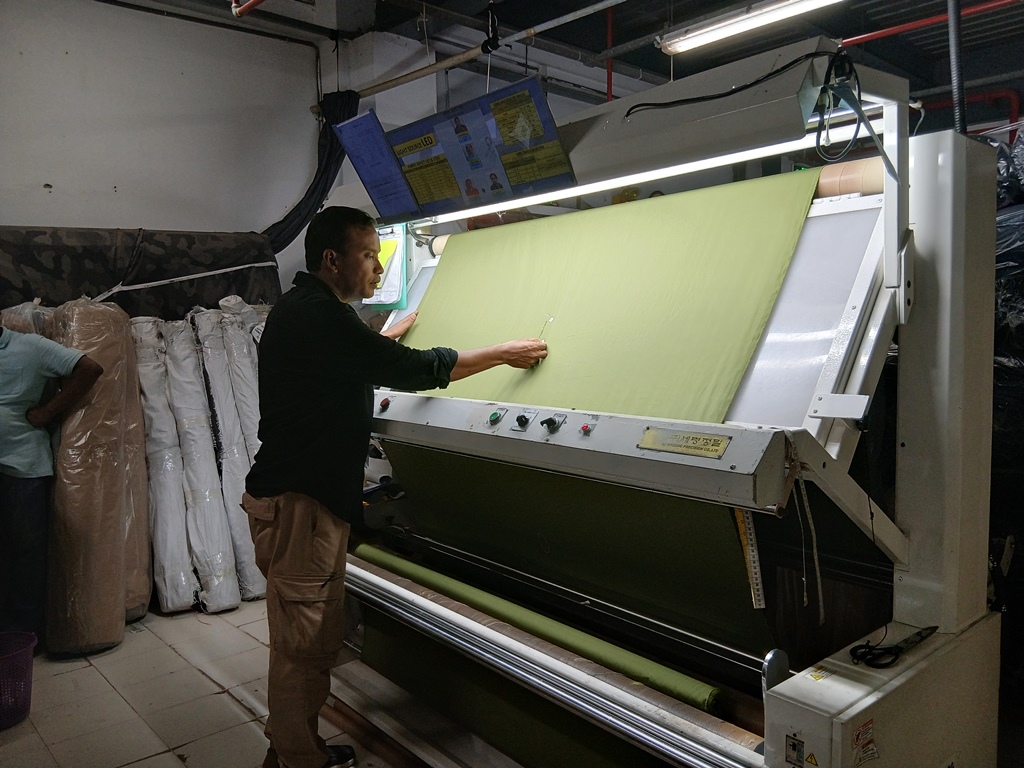
BQF Fabric Inspection & Quality Control Standards
Fabric forms the foundational blueprint of any garment or home textile product. Securing the quality of the raw material early in your product development loop will eliminate up to 80% of quality issues that could crop up on final finished goods, saving your brand from costly post-production reworks or consumer returns.
BQF provides comprehensive, professional fabric inspection and testing services across major manufacturing and textile weaving hubs in Asia. Our technical inspection checklists cover all material families, including woven, knit, denim, canvas, and synthetic PU / PVC leather.
The Fabric Quality Control Approach: The 4-Point System
To ensure objective, standardized evaluation, BQF utilizes the 4-Point System testing protocol (ASTM D5430). This inspection technique is the globally recognized industry standard for evaluating fabric rolls.
Under this system, penalty points are assigned to a roll based on the size, severity, and visibility of detected flaws. A single defect can be measured in either length or width, but no more than 4 penalty points can be assigned to any single flaw, regardless of its size.
Penalty Point Assignment Matrix
Defect Length / Width (Linear Size) | Assigned Penalty Points |
Up to 3 inches (75 mm) | 1 Point |
Over 3 inches and up to 6 inches (75 to 150 mm) | 2 Points |
Over 6 inches and up to 9 inches (150 to 230 mm) | 3 Points |
Over 9 inches (Greater than 230 mm) | 4 Points |
Note on Holes & Tears: Any structural hole, cut, or tear in the fabric body is automatically treated as a major structural failure and is assigned the maximum 4 penalty points, regardless of size.
Calculating the Total Penalty Score
A fabric roll's acceptance or rejection is determined by calculating the total penalty points per 100 linear or square yards. The standard target threshold for premium export-grade fabric is typically 40 points or fewer per 100 square yards.
The formula used by BQF inspectors to grade a roll is:
$$Points per 100 Sq. Yards = frac{Total Penalty Points imes 36,000}{Total Inspected Yards imes Fabric Width (Inches)}$$
Key Fabric Defects Monitored During Inspection
Our textile engineers evaluate fabric rolls on specialized inspection tables to catch and categorize physical defects:
    [ Weaving & Knit Flaws ]           [ Dyeing & Finishing ]             [ Material Structural ]
   ──────────────────────────         ──────────────────────────         ───────────────────────────
   • Missing Picks / Ends             • Color Shading (Side-to-Center)   • Fabric Slubs & Knots
   • Dropped Stitches (Knit)          • Color Bleeding / Smudges         • Skewing & Bowing
   • Barré Marks or Lines             • Water Stains & Oil Spots         • Pinholes & Slits
Main On-Site Tests Performed During Fabric Inspection
A visual inspection is combined with an array of rigorous physical tests conducted by BQF inspectors at the factory to confirm performance characteristics:
1.Fabric Weight Verification (GSM Test):Density & Structural Check.
Using a precision circular GSM cutter, inspectors extract fabric samples across different sections of the roll and weigh them on a calibrated digital scale. This confirms the fabric weight ($g/m^2$) matches your structural thickness requirements.
2.Total Width & Roll Length Measurements:Usable Yield Verification.
We measure the edge-to-edge width and the actual usable width (excluding selvage) at the beginning, middle, and end of the roll. The overall length is verified against the factory's packing list to prevent shortages.
3.Bowing & Skewing Tolerances:Aesthetic & Alignment Check.
For patterned, striped, or woven fabrics, we measure the percentage of distortion or curvature (bowing) and diagonal distortion (skewing). If distortion exceeds 2-3%, garments cut from this fabric will twist out of shape.
4.Shading Review & Box Assessment:Color Consistency.
Using a standard light box (D65/TL84), inspectors check for shade variations between different rolls (roll-to-roll) and within the same roll (side-to-center or end-to-end) to guarantee uniform garment panels.
5.Colorfastness Rubbing Check (Crocking):Dye & Coating Longevity.
Our inspectors conduct dry and wet rubbing tests on the fabric surface using standardized white crocking cloths. This measures the resistance of the textile's dyes to transferring onto other surfaces or skin.
Defect Classification & AQL Action Steps
Beyond the 4-Point System score, BQF checks for systemic issues that trigger an immediate review of the roll or batch:
Defect Class | Specific Fabric Conditions | BQF Inspection Action |
Critical | Strong chemical/rotten odors, mold or mildew spots, wet or damp packing conditions, or toxic residues. | Automatic Roll/Lot Rejection |
Major | Continuous defects running over 3 meters, systemic side-to-center color shading variation, or calculations exceeding 40 points per 100 sq. yards. | Fails Quality Threshold (Requires immediate mill adjustments) |
Minor | Isolated yarn slubs, small grease spots near the selvage edge, minor loose threads, or small packaging wrinkles. | Logged & Counted against roll penalty limits |
The BQF Advantage: Cutting garments from an uninspected fabric lot means that structural errors, dye variations, or shrinkage issues won't be noticed until thousands of items are sewn. BQF's strict 4-Point auditing stops problematic rolls at the mill, keeping your supply chain efficient and cost-effective.