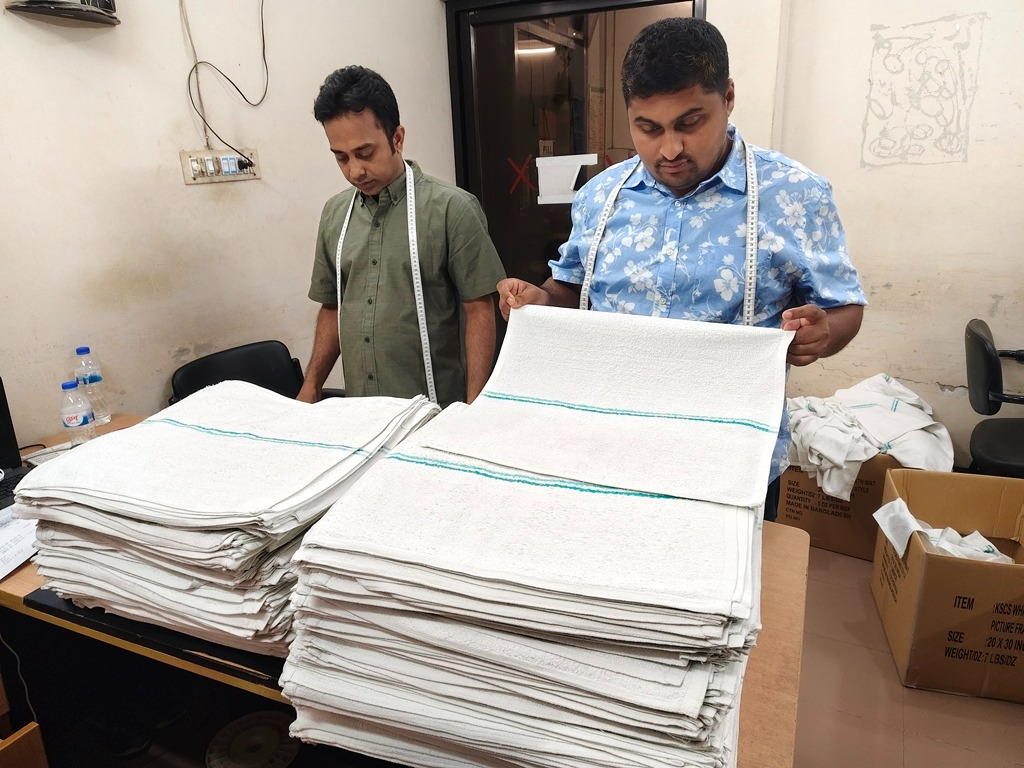
BQF Towel & Home Textile Inspection Expertise
Towels and terry products require specialized quality control due to their highly absorbent nature, pile structures, and close contact with human skin. Material inconsistencies, weaving flaws, or chemical residues can quickly compromise absorbency, alter dimensions after washing, or cause skin irritation.
BQF provides comprehensive on-site towel inspections across Asia. Our quality control checklists cover all product categories, including bath towels, hand towels, washcloths, beach towels, bathmats, and microfiber performance towels.
Critical Faults Monitored in Towel Manufacturing
Towel defects generally stem from yarn preparation, loom settings, or finishing house processes (dyeing and shearing).
[ Yarn Preparation ] ──> [ Loom Settings ] ──> [ Finishing & Dyeing ]
       │                         │                       │
       ▼                         ▼                       ▼
(Contamination)           (Weaving Flaws)        (Bleeding/Chemicals)
Our on-site inspectors look for these key issues:
Weaving & Pile Defects: Mispicks, missing filling yarns, uneven pile height, dropped loops, and visible bald patches.
Structural Failures: Poor selvage construction, wavy or puckered borders (b稳d effects), broken stitching on hems, and loose threads.
Material & Cosmetic Issues: Foreign fiber contamination, oil/grease stains from looms, fabric shading variations across the same batch, and odor problems.
Main On-Site Tests Performed During Towel Inspection
To ensure your production lot satisfies global home textile criteria, BQF conducts a rigorous series of physical testing protocols at the factory:
1.Weight per Unit Area (GSM Test):Quantity & Consistency.
The weight of a towel directly reflects its quality and absorbency. We cut fabric samples using a GSM cutter and weigh them on a precision digital scale to verify that the fabric weight ($g/m^2$) aligns perfectly with your specifications.
2.Dimensional Stability & Bowing Check:Physical Measurements.
We measure the length, width, and hem thickness of random samples against your spec sheets. We also check for bowing or skewing along the borders to prevent the towels from warping or twisting after laundering.
3.Colorfastness & Shading Review:Aesthetic Integrity.
Using a standardized light box (D65/TL84), inspectors perform a color shading check across different parts of the same towel, and between different towels in the same lot. A rub test (Crocking) is conducted to verify dye stability.
4.100% Needle Detection & Metal Scan:Safety Protocol.
Because broken sewing needles can occasionally get trapped in the dense terry loops during the hemming process, we ensure packed cartons run through an industrial metal detection system to guarantee absolute consumer safety.
5.Functional Field Checks:Absorbency & Smell.
Our team carries out quick absorption drop tests to confirm wetting action and performs smell tests to rule out chemical residues, mustiness, or damp storage odors.
Defect Classification & AQL Standards
BQF uses standard Acceptable Quality Limit (AQL) frameworks to categorize towel defects and score the production run:
Defect Class | Common Towel Imperfections | BQF Inspection Action |
Critical | Protruding metal fragments, mold/mildew, severe chemical odors, or sharp contaminants. | Automatic Lot Rejection |
Major | Severe oil stains, holes, missing borders, significant color bleeding, or dimensions outside tolerated variances. | Fails Quality Threshold if totals exceed AQL limits |
Minor | Light loose threads, slight unevenness in pile heights, small skipped stitches on the side hem, or easily removable dust. | Recorded & Monitored against acceptable limits |
The BQF Safeguard: Towels shrink and distort easily if yarn tension is neglected during production. BQF’s strict checking protocols verify pile security and weight specs at the factory, mitigating customer returns before your products load onto shipping containers.